Tuesday, March 29, 2022

RX300 Seat Renewed

 Being my first time to re-upholster a leather seat it took some time to figure out how this stuff works.  In retrospect it's logical, and when the seat goes back together you get why all the things within the seat are the way they are.  All the things within the seat work to make the finished look, feel, and functionality of the seat suit a need as a automotive seat.  You have creature comfort factors, anti-fatigue factors, safety factors, and most important some would say, looks...

A luxury car is supposed to have good looking everything.  The seats get scrutinized extra closely because you are in direct contact with them.  Well, after my RX300 got used as a work truck for more than a decade the driver seat was looking terrible.  The front passenger seat is not nearly so bad, and the back seats are hardly used because they are furled most of the time.  So the big final task that I had with the drivers seat was to remove the seat back skin from the replacement seat.  That means I had to totally disassemble another seat just to get the seat back skin.

I bought this replacement seat from a salvage yard to use in the RX300 while I was re-conditioning the original seat.  This took a lot longer than I expected.  So, above, is the replacement seat, disassembled, so that I could get the seat back skin.  Doing this for the second time took considerably less time, now that I know the construction of this seat.

I pulled both the front seats out of the RX300 which gave me an opportunity to do some deep cleaning.  I found a sub-woofer under the front passenger seat which I did not know was there.  This RX300 has the Premium Sound.  Having the seats removed allowed me to access a lot of areas I couldn't clean with the seats installed.  The whole passenger compartment is a lot cleaner now.

This is the seat back heater.  It is a lot simpler that the seat bottom heater.  It was easier to remove from the old seat skin, and easier to apply to the new seat skin.  It was a non-issue with the experience that I gleaned from re-upholstering the seat bottom.  Re-installing the Hog Rings in the seat back was also a lot easier now that I had a little experience with it.  Hog Rings work in a very specific way, and once you work with them a little you pick up their tricks.

This is one of my favorite features of the RX300 seat, above, the Lumbar Adjustment.  Over the years I had imagined how the Lumbar Adjustment works, and this isn't what I was thinking.  The way it does work is pretty logical.  There is a gear reduction motor that drives a crossbar into the Lumbar area of the seat.  When you push the control one way it drives this bar into your lower back, pushing the Lumbar Adjustment out.  When you push the control the other way it drives the Lumbar Adjustment back into the seat.  It is neat, and it is one of my favorite features of the RX300 seats.

OK, now the original seat is back in the RX300, with new leather seat skins, and it looks great.  The seat heater, as well as all the electromechanical controls all work.  The new seat bottom skin is a little off color, but that is a lot better that shredded seat skins covered with duct tape.  Plus I got to deep clean most of the passenger compartment, so it feels a lot better inside the RX300 now...

Friday, March 25, 2022

RX300 New Leather Seat Skin

 So I bought an aftermarket replacement seat skin for my RX300 driver seat.  In theory this is the correct repair.  They original seat skin was destroyed, and you should replace the damaged part, not cover it up.  There are a lot of cheap over-cover type seat covers.  I think they all look terrible because they don't fit correctly, and slip around when you sit on them.  The correct course of action here is to replace the original seat skin with a proper replacement part.

Now this was not at all as easy as I had imagined.  First the new, leather seat skin is fitted to the seat cushion, which means when it is installed it will be very tight.  This leaves no room for getting the seat skin on to the seat.  The seat skin needs to be stretched before it is installed on the seat, and then it can relax to fit the seat tightly.  Typically a upholstery shop is going to use steam to warm up the seat cover, make it more pliable, and be able to stretch the seat skin fairly easily to install the seat cover.  Well, one tool that I did not have was the steam gun, and it made this job a lot more difficult.

Another aspect to this task was to install the seat heater in the new seat skin.  The seat heater is a simple fabric form that holds a heater wire.  This wire snakes around the area of the seat cover where you are making contact with the seat.  It is a single contiguous wire that runs around the area of the seat cover.  The heater is attached to the seat cover with a spray adhesive, so it was fairly simple to remove it from the old seat cover.

I picked a medium strength spray adhesive from the hardware store to install the seat heater in the new seat cover.  Above you can see the spray adhesive, the Hog Ring Pliers, and Hog Rings.  I had some difficulty finding the Hog Rings.  They are not standard hardware store hardware, and I had to get them from the Interwebz.  So, I positioned the seat heater in the new seat cover, and adhered it in sections, carefully.  I also made sure that it was fully adhered to the seat cover before trying to install the seat cover.

You are really going to wrestle with the seat skin to get it on to the seat, and you don't want the seat heater slipping around under the seat cover when you are trying to install it.  Now for the Hog Rings.  The Hog Rings are what pulls the seat cover down into the seat cushion.  This makes that nice fitment, and prevents the seat cover from slipping around on top of the seat.  Hog Rings are the hardware that holds upholstery together.  The seat itself is a wire frame, springs, and foam cushions.  The Hog Rings hold the seat cover on to the seat.  Some of these Hog Rings are in very difficult places to access, especially the deep crevices in the middle of the seat.  It took a lot of strength, and patients to get these Hog Rings in there.  Also, I had a lot of misfires because this is my first time installing Hog Rings.  I probably used 20 Hog Rings to install 8.

So, I did get the new seat cover installed.  Is it perfect?  No...  It's my first leather upholstery experience, and I learned a lot with this experience.  It does look a lot better that the mess that the old seat cover was.  I really need the steam tool to make it look better.  When you pull off the old seat cover you should steam the seat cushions to revitalize them a little.  Then you need to steam the new seat cover before you try to install it.  With the steam you should get much better fitment.  OK, the next step in this process it to remove the seat back cover from the replacement seat in the RX300.  Then I'll install the seat back heater from the original seat into the seat back cover from the replacement seat.  Then I'll install the replacement seat back cover, and heater from the original seat on to the original seat from the RX300.  Are you following?  The end result will be the original seat from the RX300 will have new seat skins, and look a lot better than it has looked lately.


Monday, March 14, 2022

RX300 Seat Renewal

 Leather seats require regular maintenance.  The leather needs a conditioner so it is able to maintain it's elasticity.  When it is elastic, pliable it can move with the stresses that are applied to it.  If you don't condition your leather seats the leather will become hard, and crack when stresses are applied to it.  Well, my RX300 was assigned to be my work truck, and the "frilly" maintenance like leather conditioning took a low priority.  Well, eventually this took a heavy toll on the drivers seat.

As the leather got dried out, cracks started to form, and the cracks turned into tears, and so on.  My solution at the time was to cover the tears with duct tape, LOL!  Then the duct tape started to build up.  The seat kept getting harder, and less comfortable.  This came to an apex in the summer of 2019? maybe...  So, I found another seat from a salvage yard, pulled this seat out of the RX300, and replaced it with the salvage seat.  Then the original seat spent a few years sitting around my house.

For a while it was consigned to the patio, and it has become very dirty because of the weather.  These leather seats were never intended to be exposed to the weather directly.  The replacement seat that is in the RX300 now does not have a seat heater.  That is one of my favorite features of the RX300.  Mainly for my back, the seat heater, in conjunction with the lumbar support, are my favorite creature comforts in the RX300.  So, now I want to refurbish the original RX300 seat to get my seat heaters back.

The part of this seat with the biggest issues is the bottom part of the seat, the actual seat part.  The dried, cracked leather is not salvageable.  It's covered with duct tape, and the tears under the duct tape are significant.  The thing to do is to get a replacement skin, and completely replace the leather cover.  Typically a piece of leather like this might be a couple hundred dollars.  But, this is a 20 year old truck, and we can find discounted, or clearance items that will do.  The one I found, and ordered was $62.

The back of the seat is in a little better condition, but the leather is very dried out, and cracking.  This part I did try to re-condition.  I spent a few hours cleaning, and conditioning the seat back, and head rest.  The head rest was the least damaged part.  After hours of hand scrubbing the leather I only have marginal results, and I'm not really happy with it.  The head rest looks OK, but the seat back still looks pretty terrible.

So, I've hatched a plan.  I have a new seat bottom leather skin on order.  That will look great, brand new.  I don't want to pair the new seat bottom with the grungy looking seat back.  But, we have some more parts.  I have the replacement seat from the salvage yard.  It's seat back looks great, almost brand new, but it doesn't have the seat heater.  What I have to do is remove the leather skin from the salvage seat back, and then install it on the original seat that has the heater.  This is labor intensive, but I think it will be worth it in the end.  Doing upholstery is hand intensive, hard work.  The Hog Rings that hold the upholstery together are usually deeply buried within the seats, and it is difficult to get them.  But, as I progress in this project the Hog Rings are becoming familiar.  I have to get a Hog Ring Pliers, and a supply of Hog Rings to do the re-assembly.  I'm looking forward to getting my replacement parts...


Friday, February 18, 2022

Southgate

 Cedar is pretty wood.  It smells nice.  You can cook with it, like Cedar Plank Smoked Salmon.  What do you not do with Cedar?  You don't use it as fence posts.  My Old Fence...  Yeah, Cedar Posts...  On the Southgate the Latch side post has been broken, at the base, for maybe a year.  I used some old fence parts to shore it up, and keep it from moving.  Then I got tired of not being able to use Southgate.  It's my direct access to the front yard, and the mailbox, so I had motivation to fix it.  Removing the post, gate latch, and a little stub of fence that was there was easy.  I simply removed my reinforcements, picked up, and carried it away.  The Concrete Slug in the ground was another matter altogether.

Sometimes I call these stumps, which isn't really the correct term, meaning there is something left above the ground.  Slug is a better term because it is this massive, sometimes more than a hundred pounds, chunk of concrete which is buried in the Texas Clay Soil.  Sometimes I get a break, and there is a solid piece of wood that I can drive a big Eye Screw into so that I can get a handle on it.  In this case the remainder of the Cedar Post was completely rotted.  I was able to pull it apart with my hands like it was Pot Roast, and it was fibrous like that.  Slow cooked Cedar Post anyone?

When I do repairs on my fence I am going to re-double the strength of what was there originally.  I am also going to use superior building materials.  I am replacing a 4X4 Post with a 6X6 Post, which more that doubles it's area.  These posts are Yellawood, which is pressure treated Pine which is rated for ground contact.  Cedar is insect resistant, but it is a really soft wood, and is not intended to be a load bearing, structural piece, like a post.  By using the pressure treated wood I can continue the natural look of a wooden fence, but get the superior weather resistance, and structural integrity of engineered wood.

The next step is to secure it, which means more concrete.  This hole took almost two bags of concrete, maybe around 110 pounds.  I've developed a technique mixing concrete in a contractor bucket using a Sharp Shooter Space to mix it.  It's a Do what you can with what you got scheme.  I've been using this technique for several years, and it works good.  I have also evolved my Post Hole preparation technique.

At one time I was using concrete forms to shape the concrete slugs.  Don't do that.  Concrete forms make you dig the hole too wide to get the form in.  Then you have to back fill around the outside of the concrete form to fill in the air space left.  This leaves weak spots in the soil around the concrete slug which will cause your post to shift out of plumb.  Fence posts that are not straight, not plumb, look terrible.  Now, as I dig the post hole, I use the sides of the hole as the fulcrum for my digging lever, the Sharp Shooter Spade.  This compresses the soil around the upper part of the hole, and makes the footing for your fence post more solid.  When you pour the concrete, let it set, and then cure the new fence post will be very solidly secured, and will not move.  I've used this technique with the last thirteen posts I've set, and they are all doing well.

The next piece of the fence I am going to work on is the Gate.  Sure, now the gate can be opened, closed, latched, and locked.  But, it is 20 year old Cedar, and kinda floppy.  Another thing is the design of the gate.  It has no frame.  There are two 2X4 pieces attached to the hinges, and then every thing else is attached to those 2X4s.  I am astounded that it lasted 20 years.  This is the next project...


Saturday, January 29, 2022

Debugging the Information Display

 Going into this I was convinced that the backlight for the display was failing, causing the display to flash.  So, yesterday I disassembled the display, and removed the screen, and backlight portion of the display module.  The high voltage section of the backlight driver has a copper shield over it that I had to remove to get to the pulse transformers that generate the high voltage for the florescent tube backlight.  Once the shield was removed I was able inspect the electronics for the backlight driver, and to reflow the solder on all the major components there.  I didn't find any evidence of a breakdown in that area, so I re-assembled the display, and then re-installed it in the RX to test it.

While I was testing the display the backlight seemed to be on continuously, and now it looked like the data was causing the blanking effect that I had mistaken for the backlight failing.  When the RX is cold I only get information for a little while.  The data is displayed, and then the data seems to stop, the screen goes black, and then the data comes back.  This continues until I loose data altogether, and then the screen is blank, except for the backlight, which remains lit.  The nature of this failure, being intermittent, and dependent on temperature, makes me think that it is an intermittent in the connections between the computer, and the display.  So, the next course of action is to open all the connections from the display to the computer, inspect them, clean them, then re-assemble everything, and test it again.

We must dig deeper...  Imma go to Altex, and get some contact cleaner.  I also use isopropanol as a cleaning agent for contacts.  A pencil eraser will also do a good job on contacts if they are large enough to put a pencil eraser on them.  The connections I am dealing with now are small pitch surface mounted connectors, and flex cables, so we will have to use a chemical cleaner this time.


Sunday, January 23, 2022

Information Breakdown...

 My Rx, Monster Truk, has an information breakdown...  It's an electronic component thing.  Electronics work best when they have a solid state condition, and are completely isolated from mechanical movement.  Well, some electronic components are mechanical constructions, and are still vulnerable to motion, and will breakdown with vibration.  Anything that is mechanical, and moves, will breakdown faster than solid state components.  In this case I think it is capacitors.

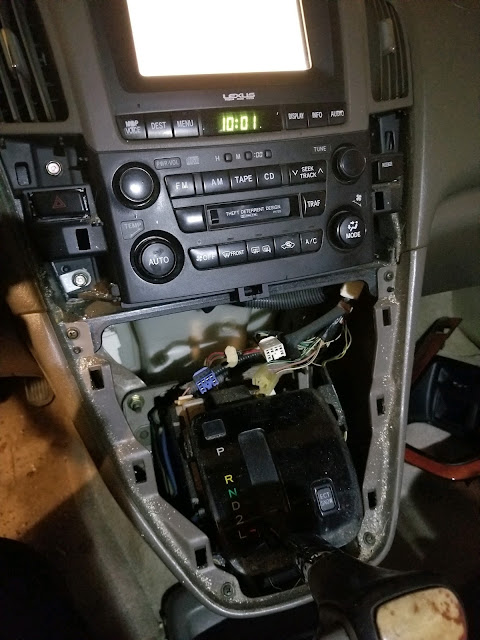
OK, lets extract the component that is in question, open it up, and look for some signs that we have failing components.  First we have to get the component out of the assembly in which it lives.  My RX is a Toyota product, so we have to deal with the interior constructions of a Toyota product.  First we need to pull some trim pieces out of the way...

The first piece you to get out of the way is the faux burl wood trim piece.  Looks neat, and does nothing...  It is secured with plastic clips around the perimeter.  Use a plastic trim pry tool to gently remove this trim piece.  I used my Mini Bar to get it started, and very gently indeed...

I am surprised at the amount of debris that is behind the things that I am removing.  So, there were a few electrical connectors I had to remove from the trim piece.  Next we can remove the four, ten millimeter screws that retain the radio, and the the upper part of the center console can be removed.  There are a considerable amount of electrical connections on the back side of the upper part of the center console, but they are all unique, and only go back into a singular location.  This make it much easier to reassemble.

OK, now, carefully, we pull off each connector, being very careful to not damage it, in order to liberater the center console facia from the vehicle.  Each connector has a latching tab that must be depressed in order to disconnect it from its mating connector.  When all the mating connectors are detached, then you can pull the Center Console Facia away from the body of the vehicle.

Now we can start to disassembly the upper center console, and isolate the display so that we can diagnose the breakdown.  Toyotas are very modular, and they have dedicated divisions that work on these individual parts.  Every sub-system in a Toyota has a dedicated subdivision of people working on that system.  In this case I have a multimedia display, with a touchscreen which has a fundamental breakdown.  The display, and touchscreen are contained in a module, with a part number, and you can go find them on the interwebz,,,

Here is a shot of the liberated Display Module.  You can search on the Interwebs to find this specific part number, and haz yourself a new display.  I'm gonna say that I am a little more adventurous, and I am going to troubleshoot this module down to failing components rather than just replace it. I might save a couple bucks, but, ultimately it is the knowledge of circuit failures is what I am after...


Saturday, January 8, 2022

Mechanical Pron

More Mechanical Pron... This is 4U-GSE (Toyota), and the FA20D (Subaru), 2.0 Liter, horizontally opposed four cylinder engine. It has chain driven dual overhead cams, direct fuel injection, and port fuel injection. It is a small displacement engine, but it is about as hot as you can make a normally aspirated engine which gives it an aggressive, sporty demeanor. It's horsepower rating is 205 HP at 7000 RPM, and that is a little more than 100 horsepower per liter of engine displacement. The main reason a normally aspirated engine can produce that level of horsepower is high compression, in this case 12.5 to 1. The Bang Boxes in this one are very efficient. Altogether what I am saying is... Lots of fun, especially when you are kicking the tail out...